
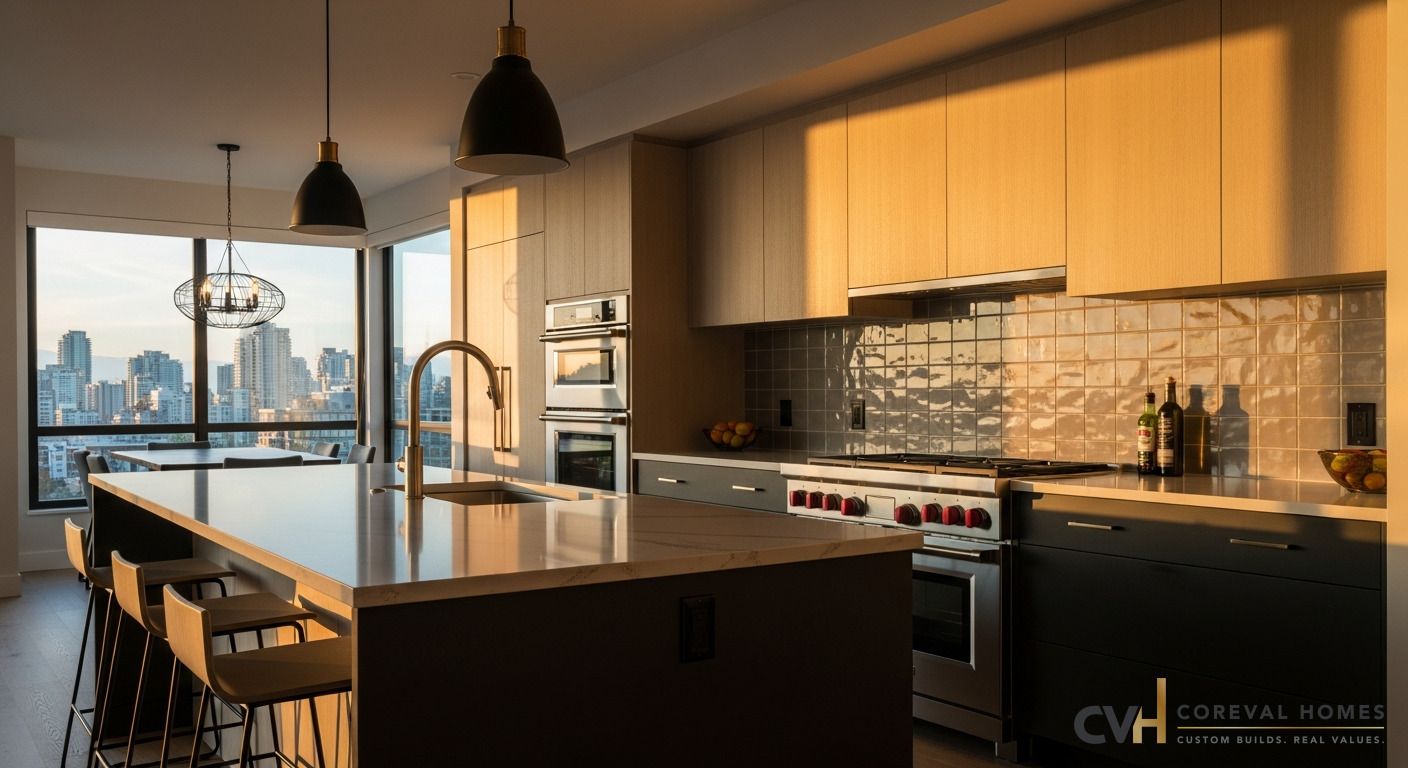
TL;DR
Kitchen renovation in Vancouver: real cost ranges, the full remodel process, permits, and custom vs stock cabinet guidance from a licensed BC builder.
The most expensive kitchen renovation mistake in Vancouver isn't the cost; it's finishing the project and realising the layout still doesn't work. The traffic flow is wrong, the island blocks the fridge, or the cabinets look fine but the rough-in was rushed. This page covers how to plan a full kitchen renovation so that doesn't happen.
If you're serious about getting your kitchen done right — layout redesigned, permits pulled, proper trades on every phase — this page covers everything you need to know.
- Scope drives cost. Layout changes, cabinet quality and mechanical work move a kitchen budget more than finishes do.
- Permits are needed for work such as electrical changes, gas line work, plumbing relocations and structural changes, and unpermitted work can surface when you sell.
- Timeline: plan for roughly 6 to 16 weeks from demolition to final punch list, plus lead time for custom cabinets, which should be ordered while permits are in process.
- BC's 2-5-10 home warranty covers new homes, not renovations, so ask any renovation contractor what written workmanship warranty they provide.
---
What's Included in a Full Kitchen Renovation?
A full kitchen renovation Vancouver scope typically covers:
- Layout and design — traffic flow, work triangle, island sizing, window and door locations
- Custom or semi-custom cabinetry — full-height, soft-close, built to the space (not around standard box sizes)
- Countertops — quartz, stone, or butcher block; templated and installed after cabinets are set
- Appliance integration — panel-ready built-ins, ventilation, gas or electric rough-in
- Electrical — dedicated circuits for appliances, under-cabinet lighting, code-compliant panel work
- Plumbing — sink relocation if required, dishwasher, pot filler if specified
- Flooring — tile, hardwood, or LVP tied into adjacent spaces
- Permits: pulled by the contractor for structural, electrical, gas and plumbing work
Cosmetic refreshes — new cabinet doors, paint, hardware — are a different category. If that's what you need, there are faster and cheaper options. Full kitchen renovation is for homeowners who want the space rebuilt properly.
The separation matters because many renovation complaints come from a mismatch between what they paid for and what they actually needed. A $25,000 cabinet refacing job on a kitchen with a broken layout solves the wrong problem. The layout is still wrong, the outlets are still in the wrong spot, and the fridge still blocks the doorway. Two years later they rip it out and start again. A proper full renovation starts with a scope document — written, signed, and priced line by line — so you know exactly what you're getting before demolition starts. If your contractor won't produce that document, they're not running a proper job.
Scope also defines what happens at the boundary. In many Vancouver kitchens, the renovation touches the dining room, the main floor bathroom wall, or the laundry closet. Decide up front whether adjacent flooring gets tied in, whether the trim gets replaced, whether the paint extends to connected rooms. These are small line items that get ugly when left ambiguous.
---
How Much Does a Kitchen Renovation Cost in Vancouver?
Kitchen renovation cost in Vancouver varies significantly depending on scope, finishes and whether structural or mechanical work is involved. Get an itemized quote that separates cabinets, countertops, trades, permits and disposal.
What drives kitchen renovation cost in Vancouver:
- Layout changes — moving the sink, island, or load-bearing walls adds plumbing, structural, and permit costs
- Cabinet quality — stock boxes from a big-box store vs. custom-built cabinetry is the single biggest variable in a mid-range project
- Appliance package — a basic range and a premium range both sit in the same rough-in; the gap is all finishes
- Trades scope — if your kitchen hasn't been touched since 1985, expect to update wiring, plumbing stacks, and ventilation
- Permit requirements — any structural, electrical panel work, or gas line work requires a permit in Metro Vancouver; factor this in from day one
Ask for written quotes with line-item breakdowns. If a contractor can't tell you what the cabinets cost separate from the countertops, that's a problem.
Two cost drivers specific to Metro Vancouver don't show up in generic national cost guides: disposal and municipal permit variability. Demolition debris has to be hauled and disposed of, and reputable contractors include that as a line item; cheaper quotes often leave it out and bill it later as an "unforeseen." Permit fees also vary by municipality, and Coquitlam, Vancouver and the District of North Vancouver each publish their own fee schedules. If you're in the Tri-Cities and your contractor quotes you a Vancouver permit number, they haven't done their homework.
Cabinet lead times matter too. Custom cabinet shops typically need weeks, not days, while stock cabinets from big-box stores are available much sooner but come with the compromises noted below. If a contractor promises a very short turnaround on custom cabinetry, ask which shop, then call the shop and verify.
---
Kitchen Renovation Process — How CoreVal Manages It
Week 1–2: Design consultation and scope sign-off We walk the space, take measurements, review what you want to change and why. We challenge assumptions — if you think you want an island, we'll tell you whether your traffic flow actually supports one.
Week 2–4: Permits and procurement Required permits are applied for. Custom cabinetry lead times are ordered at this stage — waiting until demo to order is how projects run three months over schedule.
Week 4–6: Demo and rough-in Existing kitchen comes out. Structural, plumbing, and electrical rough-in are completed and inspected before walls close.
Week 6–10: Cabinet installation and mechanical finish Cabinets are set, countertops templated. Plumbing and electrical finish work follows cabinet install — not before.
Week 10–14: Finishes and appliances Tile, flooring, appliances, lighting, hardware. Punch list completed before project sign-off.
Typical timeline: 6 to 16 weeks depending on scope and custom lead times. Any contractor quoting less than six weeks on a full renovation is either planning to rush the rough-in or hasn't accounted for permit timelines.
Sequencing matters more than calendar days. Many renovation mistakes trace back to someone skipping a phase gate — installing cabinets before the rough-in passes inspection, templating countertops before cabinets are level, or closing walls before the electrical inspector has signed off. The order of operations isn't preference; it's enforced by building code inspectors who will fail an inspection if work is buried out of sequence. A failed inspection means demo the drywall, redo the work, re-inspect. That's how a 10-week job becomes 20 weeks.
Client communication is also part of the process. Ask for a weekly schedule that shows which trade is on site each day, plus phase-gate milestones. You should know in advance when your kitchen will be without a functioning sink, when gas gets shut off for the range rough-in, and when the final walk-through is booked. If your contractor hands you a schedule with "demo, cabinets, finishes" and nothing more granular, they're not planning; they're winging it.
---
Custom Cabinets vs. Stock Cabinets — What Vancouver Homeowners Choose
This is where most renovation budgets either hold or blow up, so it's worth being direct about it.
Stock cabinets (IKEA, big-box store) work when the layout is standard, the ceiling height is standard, and you're not trying to maximise storage. They're not inferior — they're the right tool for the right job. A skilled installer can make stock cabinets look excellent.
Semi-custom cabinets are a common choice for mid-range kitchens. More finish options, better box construction, built to your ceiling height.
Full custom cabinetry makes sense in high-end projects, unusual layouts, and anywhere you need specific dimensions that no stock line will hit. Expect 8–12 weeks lead time and a significant premium over semi-custom.
What CoreVal recommends: Match the cabinet spend to the house. A premium kitchen in a modest home doesn't return what the same spend returns in a high-end home, so put the money where it makes a difference.
The other factor: resale timing. Vancouver homeowners staying 10+ years should buy the kitchen they want to live in. Homeowners planning to sell within 3 years should buy the kitchen the market wants. In most Metro Vancouver neighbourhoods, the resale kitchen is semi-custom shaker in white or light wood, quartz counters, and a slab backsplash — not because it's beautiful, but because it offends no one in a bidding war. Save the deep green island or the handle-free Italian cabinetry for a home you're keeping.
One note on Coquitlam and the Tri-Cities: many older ranchers have 8-foot ceilings and compact kitchens, and stock cabinet sizes can leave awkward gaps or soffits. If you're renovating an older Coquitlam home, compare semi-custom options before you settle on stock boxes.
---
Common Kitchen Renovation Mistakes We Fix
Bad traffic flow. The two most common culprits: an island that's too large for the space and a fridge that swings open into the main walkway. Fix it at the design stage — not after cabinets are installed.
Undersized island. Homeowners see large islands in design magazines and want one. In a small kitchen, a large island can kill the room. A peninsula or a smaller prep island usually serves the function without blocking circulation.
Wrong lighting plan. A single overhead fixture and under-cabinet LEDs is not a kitchen lighting plan. Task lighting over the sink, prep zones, and cooktop are separate circuits. Failing to rough this in early means cutting drywall later.
Skipping permits. This is the big one. Unpermitted electrical and plumbing work in a kitchen will surface at home inspection when you sell. Buyers will either walk or negotiate the cost of remediation — which is always more expensive than the permit would have been.
Hiring the cheapest quote. The lowest bid on a kitchen renovation in Vancouver is almost always missing something: allowances are unrealistically low, demo disposal isn't included, or the electrician is unlicensed.
Two additional mistakes worth naming. First: buying appliances before the cabinet shop drawings are approved. A 36" counter-depth fridge with doors that swing 180 degrees needs different clearance than a 33" standard-depth fridge with French doors. Buy the fridge before the shop drawings are final and it may not fit the opening the cabinet shop builds. The right order is: finalise cabinet shop drawings first, confirm appliance dimensions from those drawings, then order appliances. Second: picking tile and countertops before cabinets arrive. Colours look different under LED versus daylight versus the wood tone of your actual cabinets. Bring physical samples into the space and make the decision once cabinets are set, not from a showroom 60 kilometres away.
---
Vancouver Kitchen Renovation Permits — What You Need to Know
Permits are not optional on most full kitchen renovations. The City of Vancouver permit office requires permits for any electrical panel work, gas line modifications, plumbing relocations, and structural changes including load-bearing wall removal. A simple cosmetic refresh — painting cabinets, swapping a faucet on the existing stub-out, replacing a countertop without moving the sink — does not require a permit. Most full renovations need at least one.
Electrical permits cover new dedicated circuits, panel upgrades and outlet protection near counters. They are issued by Technical Safety BC or, in some municipalities such as Vancouver, the City. Electrical work should be done by a licensed electrical contractor under a permit. If your contractor tells you they have "an electrician buddy" who can do it without a permit, walk away.
Gas permits are needed to move a gas range, convert electric to gas or run a new line for a cooktop. The work must be done by a licensed gas fitter, with a permit and a final inspection.
Plumbing permits come through the local municipality, and each one posts its own fee schedule. Fees depend on the scope of work, which your contractor must report accurately.
Building permits are required for structural changes, such as removing a wall, enlarging a window opening or cutting into a floor joist for a new vent stack. Turnaround depends on the municipality, the scope and the season, which is why permit applications should start early in the project rather than at demolition.
How permit timelines affect scheduling. A common story: homeowner picks a contractor in March, demo starts in April, permits "applied for" in April, inspector visits in late June, fails inspection because rough-in is already covered. This happens because cheap contractors skip the permit phase to close the sale faster. The right sequence is: scope signed → permits applied for → cabinetry ordered → demo starts only after permits are issued. Experienced contractors follow this sequence; many handymen don't.
Unpermitted work surfaces at resale. Buyers and their inspectors can check permit history on the municipal file. If your kitchen was renovated without permits, the report flags "no permit on file for apparent electrical/plumbing modifications." Buyers then either walk, ask for a price reduction, or require you to bring the work up to code with a post-hoc permit — which is more expensive than doing it right the first time because inspectors require walls opened up to verify rough-in compliance.
---
Why Vancouver Homeowners Choose CoreVal for Kitchen Renovations
Licensed builder. CoreVal Homes is a licensed residential builder on the BC Housing registry and offers kitchen renovations across Metro Vancouver.
Warranty, explained honestly. BC's 2-5-10 home warranty under the Homeowner Protection Act applies to new homes. A kitchen renovation isn't covered by it, so ask any contractor, CoreVal included, what written workmanship warranty they provide and how long it lasts.
Transparent pricing. Ask for written quotes with line-item breakdowns, and for a change order before any scope change happens, not a surprise on the final invoice.
Coquitlam-based team. CoreVal Homes is locally operated, based at 941 Adair Ave in Coquitlam, and works across Metro Vancouver, including Vancouver, Burnaby, Coquitlam, Port Moody and North Vancouver. On a kitchen job where cabinet delivery, countertop templating and trade sequencing change week by week, a nearby team makes site supervision easier.
Licensed trades. Electrical and gas contractors in BC are licensed by Technical Safety BC, and kitchen ventilation should be designed and installed by trained trades. Ask any contractor which trades they use and how those trades are licensed.
---
Frequently Asked Questions
How long does a kitchen renovation take in Vancouver? A full kitchen renovation typically takes 6 to 16 weeks from demo start to final punch list. Timeline varies with scope: a mid-range renovation with semi-custom cabinets and no layout change runs around 6 to 10 weeks. A full custom renovation with layout changes, structural modifications, and custom cabinetry runs 12 to 16 weeks, sometimes more if permit queues are long. The variable that most often blows the timeline is custom cabinet lead time, which can run for weeks — cabinets must be ordered during the permit phase, not after demo, or the project stalls waiting on boxes.
Do I need a permit to renovate my kitchen in Vancouver? Yes, for almost any meaningful renovation. Permits are required for electrical panel work, new dedicated circuits, gas line modifications, plumbing relocations (moving the sink, dishwasher, or fridge water line off the existing stub), and any structural change such as removing a wall or enlarging a window. In the City of Vancouver, the City issues building, plumbing and electrical permits; in many other BC communities, Technical Safety BC issues electrical and gas permits. A cosmetic refresh — painting cabinets, replacing hardware, installing a new faucet on the existing plumbing stub-out — generally does not require a permit. When in doubt, your licensed contractor should handle the permit question for you. If a contractor offers to do the job without permits to save you money, that is a loud signal they should not be hired.
What's the difference between a kitchen renovation and a kitchen refresh? A kitchen refresh is cosmetic: new paint, new cabinet doors on the existing boxes, new hardware, maybe a new countertop on the same cabinet layout, and it usually takes a few weeks at most. A kitchen renovation replaces the cabinetry, often changes the layout, updates electrical and plumbing rough-in, and typically includes new appliances, flooring and lighting; it takes 6 to 16 weeks. The decision comes down to what's actually wrong with your current kitchen. If the layout works and the cabinets are structurally sound, a refresh can buy you years. If the layout is broken or the boxes are falling apart, a refresh is throwing good money after bad.
How do I find a licensed contractor for kitchen renovation in Metro Vancouver? Three checks. First, ask for business registration, liability insurance and WorkSafeBC coverage; BC Housing's residential builder licence applies to builders of new homes, not renovation contractors. Second, confirm the electrical and gas contractors are licensed by Technical Safety BC and check their licence numbers on the TSBC public search. Third, ask for three local references from projects completed in the last 24 months, then call at least two. Ask about timeline adherence, change-order transparency and whether the final invoice matched the quote. A contractor who stalls on any of these will also stall on your project.
Does CoreVal Homes handle permits, or do I need to do that myself? Handling permits is part of what a renovation contractor should do. Ask CoreVal, or any contractor, to include permit applications and inspection bookings in the scope and to show permit fees as separate line items on the quote. You shouldn't need to visit the permit office or coordinate inspector visits yourself.
---
Ready to Start Your Kitchen Renovation?
If you're planning a kitchen renovation in Vancouver and want a licensed contractor who will give you a straight answer on scope, timeline, and cost — call CoreVal Homes. You can also review our kitchen renovation service page for what a full remodel includes and how to get a quote.
604-200-2058 corevalhomes.com
We offer an initial consultation to review your space and give you an honest assessment of what your project actually involves. No pressure, no vague estimates.
Related: For more on this, see Custom Kitchen Cabinets Vancouver.
Enjoying our articles? Stay informed on real estate & development.
Make us your preferred source on Google